joi, 3 decembrie 2015

Energy In: Recommended Food & Drink Amounts for Children

Energy In: Recommended Food & Drink Amounts for Children

How Many Calories Do Children Need?

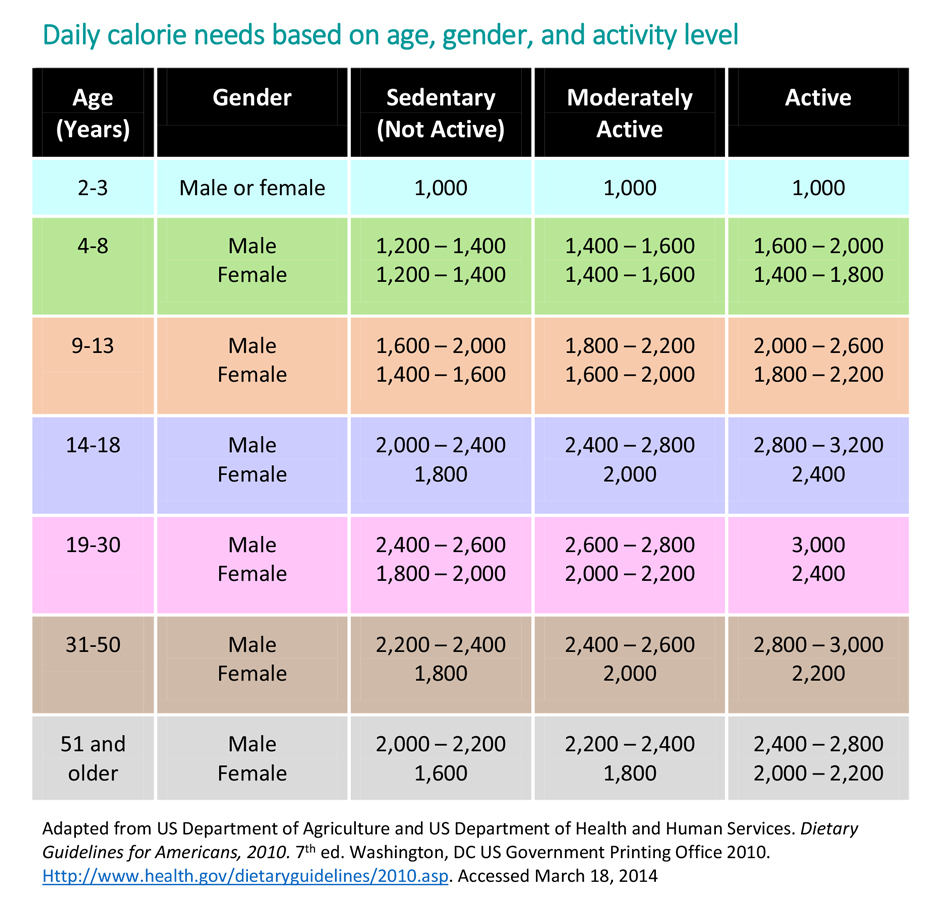
No child should be on a calorie-restricted diet, unless recommended by the doctor. However, parents need to be aware of their children's calorie needs so that they can help their children maintain energy balance.
Step 1: The chart below can give you a general idea of how many calories your child needs per day based on his or her age range, gender, and physical activity level. Walking to school is an example of being moderately active. Playing a game of basketball is an example of being vigorously active.

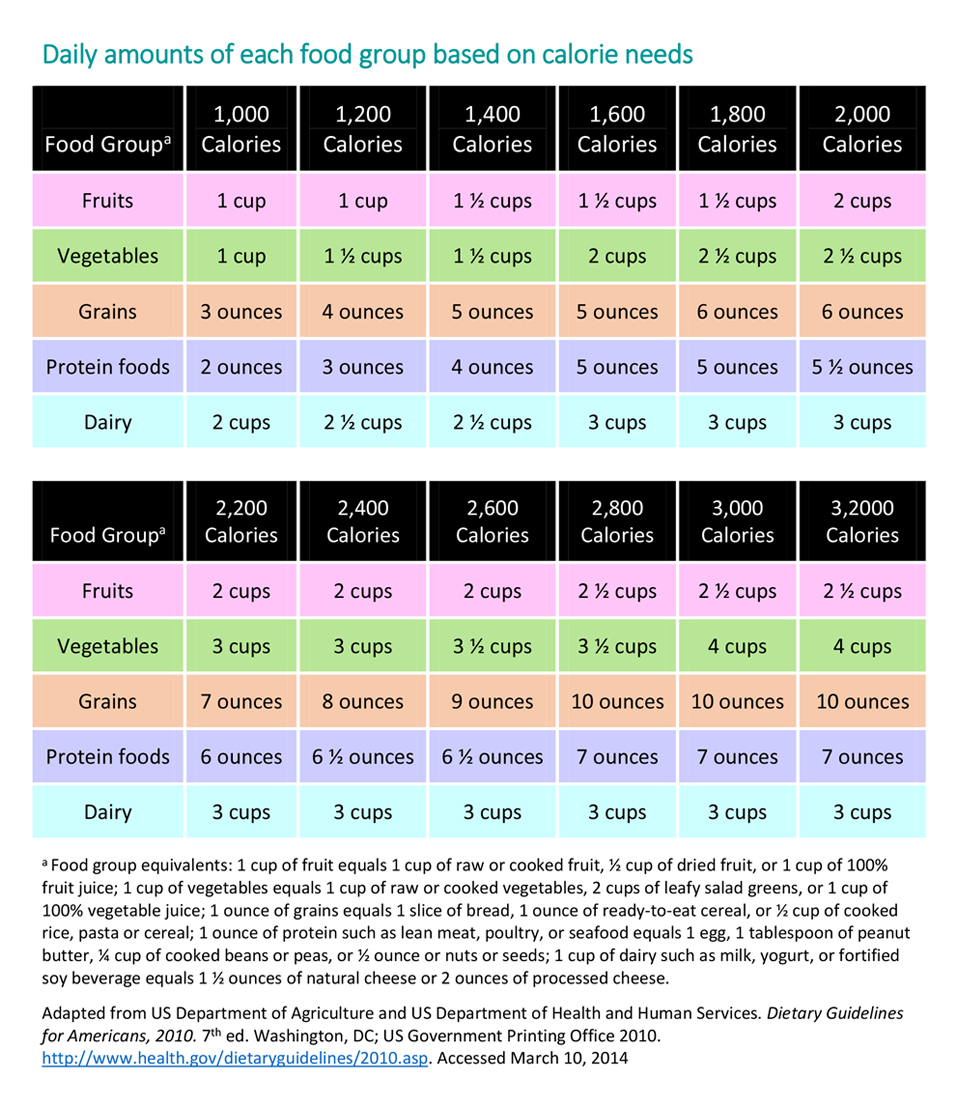
Step 2: After you find out how many calories your child needs, use the chart below to help you plan how much food from each food group to serve each day.

Keep in mind that if your child consumes extra calories beyond what is needed the calories need to be burned off with extra physical activity. Extra calories can quickly add up depending on what your children eat or drink.
For example, if your child eats or drinks an extra 100 calories each day beyond his or her calorie needs and does not burn off the extra calories, that's an extra 700 calories each week, an extra 2, 800 each month (4 weeks), or an extra 36,500 calories each year.
Step 3: Ask your child's doctor if you have any questions. Remember, these 2 charts are only a guide and each child's needs are different.

How Much Food Do Children Need?

Remember that each child's energy needs are different. For instance, your child may need more energy during growth spurts or active participation in sports. It's not necessary to eat the exact total amounts from each group every day. Rather, intake should average out over a period of 1 to 2 weeks, to ensure healthy intake of calories along with essential nutrients.
The US Department of Agriculture (USDA) recommends the following daily amounts for each food group based on different calorie needs. These are only guidelines. Another resource from the USDA and Agricultural Research Service is a Kid Energy Needs Calculator.

Eating for Good Health

Eating for Good Health

What was your initial reaction when you realized that your child needed to control his weight? In that situation, many parents find themselves thinking, “I’ve got to put him on a diet.” After all, in a culture in which thinness seems to be the name of the game and Americans just can’t get their fill of diet books, you might instinctively think that the solution rests with the latest weight-loss fad, even though these diets are rarely designed with growing children or good nutrition in mind.
No matter what some diet gurus proclaim, calorie counting and exercising to the point of fatigue are not the answer, particularly for children. In fact, restricting calories in a growing child could pose risks to his health. You shouldn’t do so unless your pediatrician recommends and supervises those efforts.
So what’s the answer? Consistently good nutrition, meal after meal, is a foundation for a healthy childhood. Rather than becoming preoccupied with weightloss goals, you should focus instead on a wholesome lifestyle for everyone in your family, no matter what each member weighs. Establish some structure to your family’s eating—3 well-thought-out meals and 2 snacks a day. If you take steps to minimize the junk food in your family’s diet, eliminate sugared beverages like soft drinks, pay attention to portion sizes, and add some physical activity to the mix, your heavy child will grow up to have a healthy weight.
In preparing foods high in nutritional value, build the family meals around selections like:
  • Fresh fruits and vegetables
  • Whole-grain cereals and bread
  • Low-fat or nonfat dairy products like milk, yogurt, and cheeses
  • Lean and skinless meats including chicken, turkey, fish, and lean hamburger
The basics of good nutrition really aren’t that complicated. It means choosing low-fat turkey bologna instead of beef, or preparing a grilled chicken sandwich instead of a high-fat cheeseburger. Portion sizes at this age should be less than that of an adult-sized serving. Remember that when you’re in the kitchen, choose cooking methods that involve a minimal amount of fat, relying primarily on broiling, roasting, and steaming.
During the middle years of childhood, there are plenty of obstacles that can trip up your well-intentioned efforts at keeping your family eating right. In the mornings, as you’re rushing to get your child off to school, are there days when he doesn’t have the time to sit down for a nourishing breakfast? At school, does he sometimes make poor choices in the cafeteria or from vending machines?
As a parent, part of your responsibility is to find solutions for any stumbling blocks that arise. If the school cafeteria doesn’t offer many healthy choices or your child cannot be convinced to purchase healthy options (and in many elementary and middle schools, only one lunch entrée is provided), pack a healthy lunch for your child each day. You might prepare a turkey sandwich on multigrain or pita bread. A peanut butter and jelly sandwich is fine, too. There are plenty of good selections, but stay away from pastrami, salami, and other high-fat lunch meats. Add a piece of fruit to your child’s lunch sack and perhaps a bag of pretzels. Pack a small water bottle for him, or give him money to buy low-fat milk in the cafeteria.
Once your child gets home from school, he might head straight for the cupboard or refrigerator and look for something to munch on. Have some healthy snacks for him to choose from—raw vegetables with nonfat dip, fresh fruit, whole-grain crackers, air-popped popcorn, unsalted pretzels, or baked tortillas with salsa. Keep the ice cream, cookies, and cakes out of reach—or better yet, out of the house altogether (reserve them for special occasions). If you don’t limit access to snack foods like these, you’re unfairly setting your child up for a losing battle against weight gain.
Meanwhile, stay alert for other potential stumbling blocks to healthy eating. For example, your school-aged child may sometimes exchange food with friends, giving up the sandwich and fruit that you’ve packed for him and trading them for a bag of potato chips. After school, if he’s spending time at a playmate’s home, he might be snacking there on candy rather than an apple. In short, even if you’ve done a good job of educating your child on making nutritious food choices, he’ll face plenty of temptations, almost on a daily basis.
Also remember that you’re a role model in this process, so make healthy food choices for yourself as well as the rest of the family. Even though school-aged children are busier than ever, make an effort to find time for family meals as often as possible. When all of you sit down at the dining room table together, it’s a perfect opportunity for every family member to describe his or her day and the family to grow closer.

Diagnosing Food Allergies in Children

Diagnosing Food Allergies in Children

Many types of food can cause allergic reactions in middle childhood. The most common of these are cow's milk and other dairy products, egg whites, poultry, seafood, wheat, nuts, soy, and chocolate.
Allergies are caused by antibodies that the body's immune system pro­duces, which react to a component of a particular food and then release chem­icals that cause allergic symptoms like a runny nose, sneezing, coughing, and itching.
Children may also experience stomach pain, bloating, cramping, diar­rhea, skin rashes, and swelling. Although these reactions can occur almost im­mediately after consuming these foods, they may be delayed for hours or sometimes even days.
Diagnosing food allergies is not easy. Identical symptoms may be caused by other disorders, and pinpointing the offending food can be difficult. Your pe­diatrician may refer your child to an allergist, who has several diagnostic op­tions. The allergist might suggest an elimination diet, a procedure in which suspicious foods are removed from the diet for a period of time and symptoms are closely monitored to see if they subside. After several weeks the foods are reintroduced one by one, and allergic responses are again evaluated to deter­mine which food, if any, is really the cause of the problem.
Your doctor might also use skin and blood tests. He or she might prick the skin on your child's back or arm, and then introduce a liquid extract of the suspicious food to see if a response—swelling and itchiness, for example— takes place. However, while the validity of this test is widely accepted in diag­nosing airborne allergies, there is controversy about its reliability in detecting food allergies.
Some doctors also use the RAST test, in which a sample of your child's blood is mixed with food extracts. Then the blood is evaluated to determine whether antibodies to that food are present. The reliability of this test may vary from laboratory to laboratory.
Once an offending food has been identified, your doctor will probably rec­ommend that it be removed from your child's diet. This means not only elimi­nating eggs, for example, but also all products that contain them. As a result, you may have to become more diligent reading labels in the supermarket. A child allergic to wheat gluten, for instance, may have to avoid most grains, including cookies, pies, cakes, and pasta, as well as processed cheese, salad dressings, and many other foods. The situation becomes even more challeng­ing if your child is allergic to several food items.
Ask your doctor to suggest alternatives to the foods to which your child is allergic. Can egg substitutes be used for a youngster allergic to eggs? When a child is allergic to milk, should she eat additional protein-rich foods (legumes, chicken, fish, meat) and calcium-rich items (sardines, broccoli, spinach)? Can other products be consumed in place of cow's milk? If your child is allergic to wheat, can you cook with corn flour or rice flour instead?
Last Updated
11/21/2015
Source
Caring for Your School-Age Child: Ages 5 to 12 (Copyright © 2004 American Academy of Pediatrics)

Childhood Nutrition

Childhood Nutrition

Hey, What’s to Eat?

Unless you’ve been totally out of the loop, it’s likely you’ve heard about the childhood obesity epidemic. Nearly 1 in 3 children in America is overweight or obese. It’s talked about on television, radio, the Internet, and in books, newspapers, and magazines. Yet, with all this focus on kids being overweight and obese, many parents are still confused, especially when it comes to what kids eat. How much does your child need? Is he getting enough calcium? Enough iron? Too much fat?
Whether you have a toddler or a teen, what he eats is important to both his physical and mental development. Here’s what children need — no matter what the age.

Infants

During this stage of life, it’s almost all about the milk — whether it’s breast milk, formula, or a combination of the two. Breast milk or formula will provide practically every nutrient a baby needs for the first year of life, says Jennifer Shu, M.D., FAAP, a pediatrician at Children’s Medical Group in Atlanta and co-author Food Fights: Winning the Nutritional Challenges of Parenthood Armed with Insights, Humor, and a Bottle of Ketchup, published by the American Academy of Pediatrics (AAP).
At about six months most babies are ready to start solid foods like iron-fortified infant cereal and strained fruits, vegetables, and pureed meats, Dr. Shu says. Because breast milk may not provide enough iron and zinc when babies are around six to nine months, fortified cereals and meats can help breastfed babies in particular, she explains.
Once you do start adding foods, don’t go low-fat crazy. Although the AAP recently released updated guidelines stating fat restriction in some babies is appropriate, in general, “you don’t want to restrict fats under age two because a healthy amount of fat is important for babies’ brain and nerve development,” says Dr. Shu.

Toddlers and Preschoolers

“Toddlers and preschoolers grow in spurts and their appetites come and go in spurts, so they may eat a whole lot one day and then hardly anything the next,” says Loraine Stern, M.D., FAAP, a clinical professor of pediatrics at the UCLA School of Medicine. It’s normal, and as long as you offer them a healthful selection, they will get what they need, she says.
One area parents should probably keep under watch is calcium. Calcium, the body’s building block, is needed to develop strong, healthy bones and teeth. Children may not believe or care that milk “does a body good,” but it is the best source of much-needed calcium.
Still, there’s hope for the milk-allergic, lactose-intolerant, or those who are just impartial to milk. Lactose-free milk, soy milk, tofu, sardines, and calcium-fortified orange juices, cereals, waffles, and oatmeal are some calcium-filled options. In some cases the doctor may recommend calcium supplements.
Fiber is another important focus. Toddlers start to say “no” more and preschoolers can be especially opinionated about what they eat. The kids may want to stick to the bland, beige, starchy diet (think chicken nuggets, fries, macaroni), but this is really the time to encourage fruits, vegetables, whole grains, and beans, which all provide fiber, Dr. Shu says. Not only does fiber prevent heart disease and other conditions, but it also helps aid digestion and prevents constipation, something you and your child will be thankful for.

Elementary School

Don’t be surprised if your child quits meat. “It isn’t uncommon for a 6- or 7-year-old to suddenly decide to be a vegetarian once they understand animals and where food comes,” Dr. Stern says. This doesn’t mean she won’t get enough protein. “Animal tissue isn’t the only place we get protein,” Dr. Stern says. Rice, beans, eggs, milk, peanut butter — all have protein. So whether your child goes “no-meat” for a week or for life, she’ll likely still get sufficient amounts of protein.
Areas that might be a little too sufficient are sugars, fats, and sodium. “This time is when kids first go to school and have a little bit more choice in what they eat, especially if they’re getting it in the cafeteria themselves,” Dr. Shu says. Cakes, candy, chips, and other snacks might become lunchtime staples. The body needs carbs (sugars), fats, and sodium, but should be eaten in moderation, as too much can lead to unneeded weight gain and other health problems. Packing your child’s lunch or going over the lunch menu and encouraging her to select healthier choices can help keep things on track, Dr. Shu says.

Preteens and Teens

As puberty kicks in, young people need more calories to support the many changes they will experience. Unfortunately, for some, those extra calories come from fast food or “junk” foods with little nutritional value. Some adolescents go the opposite way and restrict calories, fats, or carbs. Adolescence is the time kids start to become conscious of their weight and body image, which, for some, can lead to eating disorders or other unhealthy behaviors, Dr. Stern says. She recommends parents keep an eye on things by being aware of changes in eating patterns and making family dinners a priority once or twice a week.
Like calories, calcium requirements are higher. Calcium is more important than ever during the tween and teen years because the majority of bone mass is built during this time. However, fewer than 10 percent of girls and just more than 25 percent of boys ages 9 to 13 are at or above their adequate intake of calcium. Encouraging kids to have milk, milk products, or calcium-rich alternatives, even if it means they have to add chocolate syrup to their milk to make it more palatable, should help them get more calcium.
In addition to more calories and calcium, your child’s gender may play a role in whether he or she needs more of a particular nutrient. For instance, teen girls need more iron than their male counterparts to replace what’s lost during menstruation, and males need slightly more protein than girls.
Although getting your child to eat healthy — regardless of his or her age — can be a constant battle, it’s one well worth fighting. A healthy child becomes a healthy adult, and only with your support and guidance will your child be both.
 Age Fruits(Cups) Vegetables(Cups) Grains(ounces) Meats &                   Beans(ounces) Milk(Cups)
 2-3  1  2   3  2  2
 4-8  1-1½  1½  4-5  3-4  2
 9-13(females)  1½  2  5  5  3
 9-13 (males)  1½  2½  6  5  3
 14-18(females)  1½  2½  6  5  3
 14-18 (males)  2  3  7  6  3

Quick Tips: Drink Up!

Water makes up more than half of kids’ body weight and is needed to keep all parts of the body functioning properly.
  • There’s no specific amount of water recommended for children, but it’s a good idea to give them water throughout the day — not just when they’re thirsty.
  • Babies generally don’t need water during the first year of life.
  • If your child doesn’t like the taste of water, add a bit of lemon or lime for flavor.
  • Fruits and veggies are also good sources of water.
  • Kids should drink more water when ill, when it’s hot out, or when engaged in physical activity.

Quick Tips: Give This...

Here’s what the United States Department of Agriculture (USDA) recommends kids get calorie-wise and from each food group for a healthy, balanced diet:
Calories*
  • 2-3 years: 1,000
  • 4-8: 1,200-1,400
  • 9-13 (female): 1,600
  • 9-13 (male): 1,800
  • 14-18 (female): 1,800
  • 14-18 (male): 2,200
* For active children, calorie requirements may be greater 
This article was featured in Healthy Children Magazine. To view the full issue, click here.

Are Your Kids Hungry or Just Bored?

Are Your Kids Hungry or Just Bored?

​Children (as well as adults) often use food for reasons other than to satisfy hunger. Children often eat in response to their emotions and feelings.
If your child seems hungry all the time, use the following tips to get a better idea of what is really going on.

What Triggers Hunger?

If your child is eating 3 well-balanced meals and 1 snack a day but still claims to be hungry, there may be other reasons beyond hunger that make him or her want to eat.

What You Can Do

Ask yourself the following questions:
  • Does your child sometimes reach for food when experiencing any of the following?
  • Does your child eat at times other than regular mealtimes and snacks? Is your child munching at every opportunity?
  • Do you reward your child with food (does an A on a test sometimes lead to a trip to the ice cream shop)? This can inadvertently contribute to your child’s obesity.
  • When your child is doing things right, do you tell him or her? Words of approval can boost a child’s self-esteem. They can also help keep a child motivated to continue making the right decisions for health and weight.
  • How are you speaking to your child? Is it mostly negative? Is it often critical? It’s hard for anyone, including children, to make changes in that kind of environment.

Healthy Alternatives

If you suspect your child is eating out of boredom, you may need to steer him or her toward other activities as a distraction.

What You Can Do

  • Make sure your child is eating 3 well-balanced meals and 1 snack a day. This will prevent feelings of hunger between meals.
  • Help your child choose other things to do instead of eating, such as:
    • Walking the dog
    • Running through the sprinklers
    • Playing a game of badminton
    • Kicking a soccer ball
    • Painting a picture
    • Going in-line skating
    • Dancing
    • Planting a flower in the garden
    • Flying a kite
    • Joining you for a walk through the mall (without stopping at the ice cream shop)
  • Offer healthy snacks such as raw vegetables, fruit, light microwave popcorn, vegetable soup, sugar-free gelatin, and fruit snacks. Snacks such as chips and candy bars have empty calories that will not make your child feel full.
  • You pick the snack. When children are allowed to pick their own snacks, they often make unhealthy choices. Talk to your child about why healthy snacks are important. Come up with a list of snacks that you can both agree on and have them on hand.

Remember

Your own relationship with food and weight, dating back to your childhood, can influence the way you parent your own child. One of your biggest challenges is to determine whether your child is eating for the right reasons.
Last Updated
11/21/2015
Source
Pediatric Obesity: Prevention, Intervention, and Treatment Strategies for Primary Care (Copyright © 2014 American Academy of Pediatrics)
The information contained on this Web site should not be used as a substitute for the medical care and advice of your pediatrician. There may be variations in treatment that your pediatrician may recommend based on individual facts and circumstances.